Appointments Required
To give every patient our full care, we cannot take walk-ins.
Please schedule your visit.
Please schedule your visit.

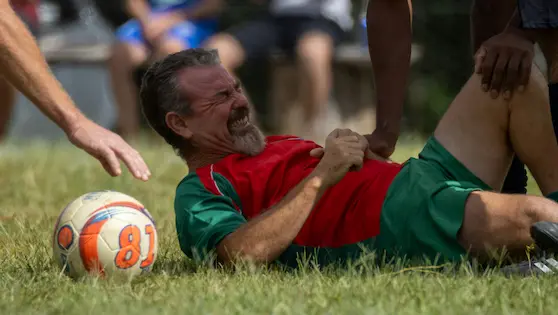
If you’re dealing with a sports injury and the pain isn’t going away, simply resting for a few more days isn’t always the answer.
Most people expect an injury to gradually improve once they stop the activity that caused it. But sometimes the pain continues when you return to training, comes back every time you play, or starts affecting everyday movements as well as sport.
Persistent pain doesn’t necessarily mean that something serious is wrong. However, it can be a sign that the injury needs a closer look, that your training load needs to change, or that your recovery hasn’t progressed enough for you to safely return to your previous level of activity.
For people looking for sports injury treatment in Brisbane, the first step is understanding why the pain may still be there and what the next stage of recovery should look like.
Sports injuries can happen suddenly or develop gradually.
A sudden injury might occur when you land awkwardly, change direction quickly, collide with another player or overstretch a muscle. Sprains and strains are common examples.
Other injuries develop over time. Repeated training, increased workload, poor recovery or repeatedly performing the same movement can gradually irritate muscles, tendons or joints.
Healthdirect notes that injuries such as sprains and strains can take time to heal, while persistent symptoms may warrant further assessment.
There are several reasons pain may continue:
Sometimes the pain has also changed from the original injury. For example, the initial swelling and sharp pain may have settled, but you may still notice stiffness, weakness or discomfort when performing a particular sporting movement.
That is why persistent pain deserves attention rather than simply being ignored.
This is a common pattern.
You may feel relatively comfortable while walking around or doing normal daily activities. Then you return to football, running, tennis, gym training or another sport and the pain returns.
That doesn’t necessarily mean you have re-injured yourself.
Sport places considerably different demands on the body compared with ordinary daily activities. Running, jumping, accelerating, changing direction and lifting can all place greater loads on muscles, tendons and joints.
Your body may therefore tolerate everyday activities while still struggling with the demands of your sport.
Instead of asking only:
“Does it hurt?”
it can be more useful to consider:
“What can I currently do comfortably, and what causes the symptoms to increase?”
That distinction can help guide a gradual return to activity.
This depends on the injury and the type of pain.
Some mild muscle soreness after exercise is different from pain associated with an injury. Continuing an activity that repeatedly makes an injury worse is unlikely to be a sensible recovery strategy.
Healthdirect recommends listening to your body and stopping an activity if it hurts, particularly when there is concern about an injury.
This doesn’t necessarily mean you need complete rest.
For some injuries, appropriate movement and a gradual return to activity can form part of recovery. The important point is that the activity should be appropriate for the current stage of recovery rather than simply returning immediately to the same training programme.
Consider professional assessment if:
Healthdirect recommends seeing a doctor when a sprain or strain is causing significant pain, when there is uncertainty about a fracture or dislocation, or when symptoms are not improving within a week.
Persistent tendon pain also deserves attention, particularly if it interferes with sport or daily activities or continues to worsen.
The exact timeframe varies depending on the injury, its severity and the person. The important point is not to assume that ongoing pain is something you simply have to put up with.
A good assessment should start with understanding what happened.
You may be asked:
The physical assessment may then look at movement, strength, joint function and how symptoms respond to particular movements.
This information can help determine whether the problem appears appropriate for conservative care or whether further medical investigation is needed.
It can also help identify factors that may be contributing to the problem beyond the painful area itself.
Returning to normal daily activities is not necessarily the same as returning to sport.
For example, someone recovering from a lower-limb injury may be able to walk comfortably but still struggle with:
Similarly, someone recovering from an upper-body injury may manage everyday activities but experience pain when lifting, throwing, serving or performing repetitive gym exercises.
This is why rehabilitation is often more than simply waiting for pain to disappear.
The Australian Institute of Sport describes rehabilitation for complex sporting injuries as a tailored process that can involve multiple areas of expertise and ongoing review of the rehabilitation plan.
For recreational athletes, the same basic principle applies: recovery should progress according to what your body can currently tolerate rather than according to a fixed timetable.
One of the most overlooked factors in sports injuries is a sudden change in training load.
Perhaps you’ve:
The body needs time to adapt to changes in physical demand.
If your training increases substantially while your recovery remains the same, the tissues involved may struggle to keep up.
This doesn’t mean that exercise is bad for an injured body. It means that the right amount of exercise at the right stage of recovery matters.
The appropriate approach depends on the injury, but some general principles can help.
If a particular movement consistently increases your symptoms, temporarily modifying that activity may be sensible.
This doesn’t necessarily mean becoming completely inactive.
For many musculoskeletal problems, appropriate movement can be preferable to avoiding all activity.
The key is to choose activities that do not significantly aggravate your symptoms and to progress gradually.
Feeling better does not always mean you’re ready to return to full-intensity sport.
A gradual progression from everyday movement to training and then competition may be more appropriate than going directly from rest to a full game.
If the same problem repeatedly returns every time you increase your training, that’s useful information.
Rather than repeatedly treating each flare-up as a separate event, consider having the overall problem assessed.
Not every sporting injury should be managed by a chiropractor or other musculoskeletal practitioner.
Some injuries require medical assessment or urgent care.
Seek medical attention if you have significant pain, major swelling, difficulty moving the injured area, or you are concerned that you may have a fracture or dislocation.
After a head injury, symptoms such as confusion or loss of consciousness require urgent attention. Healthdirect advises calling triple zero (000) if someone is confused or unconscious following a head injury.
Back injuries also have specific warning signs. Urgent assessment is required for symptoms such as new bladder or bowel changes, numbness around the groin or anus, significant weakness or numbness in the legs, or rapidly worsening symptoms.
If you’re unsure what level of care you need in Australia, healthdirect also provides a symptom checker and health advice service.
Chiropractic care can be one part of a broader approach to some musculoskeletal sporting problems.
An assessment can look at the injured area as well as related movement and musculoskeletal factors. Depending on the individual problem, care may include hands-on treatment, advice about activity modification and exercises or other strategies designed to support recovery.
The important point is that treatment should be individualised.
A sports injury isn’t simply a painful body part that needs to be “fixed”. The appropriate approach depends on the injury, the person’s health, their sporting demands and how they are progressing.
If the assessment suggests that medical review, imaging or another form of healthcare is more appropriate, referral should be considered rather than continuing treatment that isn’t suitable.
A common mistake is using pain alone as the test.
Instead, consider whether you can progressively tolerate the movements and demands of your sport.
Depending on the activity, that might include:
The exact progression will vary considerably between injuries and sports.
A footballer, runner, swimmer and weightlifter will not have identical return-to-sport requirements.
If symptoms repeatedly appear when you increase intensity, that’s a reason to reassess rather than simply pushing harder.
It’s easy to accept an injury when it has been around for weeks or months.
You might tell yourself:
“It only hurts when I run.”
“It only hurts after football.”
“It goes away after a couple of days.”
“I’ve had it for ages, so it’s probably nothing.”
But recurring pain is still worth paying attention to.
Persistent pain can affect training, sleep, work and everyday activities. Healthdirect describes persistent or chronic pain as pain that continues beyond the expected healing time and notes that it can have a significant impact on daily life.
You don’t necessarily need to stop the activity you love permanently. The goal of appropriate assessment and rehabilitation is often to understand what is happening and work towards a safe return to the activities that matter to you.
If you’ve picked up an injury playing football, running, going to the gym, cycling, playing tennis or participating in another sport and the pain isn’t settling, an assessment may help clarify what is going on.
At Angel Chiropractic in Annerley, Brisbane, sports-related musculoskeletal problems can be assessed on an individual basis, with care tailored to the person’s symptoms, activity level and goals.
If you are unsure whether chiropractic care is appropriate for your particular injury, you can contact the clinic to discuss your situation and determine whether an assessment is suitable.
And if your symptoms suggest that you need medical assessment or urgent care instead, that should take priority.
Don’t simply accept recurring pain as part of playing sport. Understanding the problem is the first step towards making a sensible plan for getting back to doing what you enjoy.
Persistent sports injury pain can have several causes, including incomplete recovery, returning to sport too quickly, changes in training load, reduced strength or mobility, or an injury that needs further assessment. If symptoms are not improving or repeatedly return when you resume sport, professional assessment may be appropriate.
It depends on the injury and the activity. You may need to reduce or temporarily stop activities that aggravate your symptoms, but complete inactivity is not necessarily required for every injury. A gradual return to appropriate activity may form part of recovery.
Consider assessment if your pain is not improving, repeatedly returns during sport, affects your daily activities or performance, or is associated with significant swelling, weakness, restricted movement or instability. Healthdirect recommends medical assessment when sprain or strain symptoms are not improving within a week.
Chiropractic care may be appropriate for some musculoskeletal sports injuries. An assessment can help determine whether conservative musculoskeletal care is suitable and whether referral for medical assessment or another form of care is needed.
There is no single timeframe that applies to every injury. Return to sport should take into account the type and severity of the injury, your symptoms, strength, movement and ability to tolerate the demands of your particular sport.
To find out more:
Discover our other blog posts on our [Blog Hub].

Justice of the Peace
(Qua)
I had an amazing experience with Angel . From the moment I walked in, I felt welcomed and comfortable. Angle took the time to listen to my concerns and thoroughly explained the treatment plan. The adjustments were gentle yet effective, and I noticed a significant improvement in my pain after just a few sessions. The staff is also incredibly friendly and professional, making each visit a pleasure. I highly recommend Angel to anyone seeking top-notch chiropractic care!